When Your Business Needs a Fractional CFO

7 Signs You've Outgrown Your Bookkeeper
The $3 Million Inflection Point
Most professional services firms hit a wall somewhere between $3M and $5M in revenue.
The books are clean. Invoices get sent. Taxes get filed. But founders find themselves asking questions their bookkeeper can't answer:
Can I afford to hire three people this quarter, or just one?
Why does my bank account feel tight when my P&L shows profit?
Which service lines actually make money after we account for everything?
What happens to cash if we lose our largest client?
These aren't accounting questions. They're strategic finance questions—and they signal you've outgrown bookkeeping.
This article breaks down the seven specific signs that indicate your business needs fractional CFO support, what that actually means, and how to know if you're ready.
What Is a Fractional CFO? (And What It's Not)
A fractional CFO provides executive-level financial leadership on a part-time or project basis. Unlike bookkeepers or controllers who focus on recording what happened, fractional CFOs focus on what happens next:
Cash forecasting and scenario modeling
Strategic planning and growth decisions
Margin analysis and pricing strategy
Risk management and financial controls
Board-level reporting and KPI frameworks
What a fractional CFO is NOT:
A replacement for your bookkeeper (you still need clean books)
Someone who processes payroll or pays bills
A tax accountant or CPA
A full-time employee with benefits and overhead
Think of it this way: Your bookkeeper tells you where you've been. Your fractional CFO tells you where you're going—and what it will cost to get there.
The 7 Clear Signs You Need a Fractional CFO
1. You're Making Hiring Decisions Based on Gut Feel, Not Cash Runway
The Signal: You want to add headcount, but you're not sure if you can afford it. Your P&L shows profit, but your gut says "wait." You hire anyway—or you don't—and three months later, you wish you'd done the opposite.
Why This Matters: Hiring is the single largest cash decision most professional services firms make. One bad hire can cost $150K+ in salary, benefits, ramp time, and opportunity cost. Without a forecast that models different hiring scenarios, you're gambling.
What a Fractional CFO Does: Builds a 12-month rolling cash forecast that shows exactly what happens if you hire one person in Q2, three people in Q3, or wait until Q4. You make the decision with data, not fear.
2. Your Bank Balance Doesn't Match Your P&L
The Signal: You're showing $40K in monthly profit, but your checking account balance hasn't moved in six months—or worse, it's dropping. You're confused, frustrated, and wondering where the money went.
Why This Matters: This is the classic cash vs. accrual gap. Profit on paper doesn't equal cash in the bank. Timing differences—receivables, payables, tax reserves, debt payments, owner draws—can create a phantom profit problem.
What a Fractional CFO Does: Reconciles cash to accrual, identifies where cash is leaking (AR aging, over-servicing, hidden costs), and installs a cash discipline cadence so you always know your true liquidity position.
3. You Don't Know Your True Cost to Deliver
The Signal: You price projects based on market rates or what "feels right." You know your gross margin in aggregate, but you don't know which clients, service lines, or project types are actually profitable after accounting for labor, revisions, and overhead.
Why This Matters: Revenue is not profit. If you're running a $5M firm at 30% gross margin, but your top service line is actually margin-negative after true cost allocation, you're growing yourself into a loss.
What a Fractional CFO Does: Builds job costing or service line P&Ls that show exactly where margin is created or destroyed. You stop guessing and start pricing, staffing, and selling based on truth.
4. You've Been Surprised by a Tax Bill, Twice
The Signal: Your CPA tells you in March that you owe $60K by April 15. You scramble. You promise yourself you'll plan better next year. Then it happens again.
Why This Matters: Tax obligations are predictable if you forecast them. If you're being surprised by taxes, you don't have a tax problem—you have a forecasting problem.
What a Fractional CFO Does: Models tax liability monthly based on projected income, sets aside reserves, and coordinates with your CPA to eliminate surprises. Estimated payments become routine, not emergencies.
5. You're Considering a Major Investment (New Office, Acquisition, Product Line) and Don't Know If You Can Afford It
The Signal: You're evaluating a lease expansion, buying a competitor, or launching a new service. The opportunity feels right, but you're not sure what it does to cash flow, payback timeline, or risk exposure.
Why This Matters: Big bets require modeling. Without scenario planning, you're making irreversible commitments based on hope. Hope is not a cash flow strategy.
What a Fractional CFO Does: Builds financial models that stress-test the decision under best-case, base-case, and worst-case scenarios. You see the risks, the returns, and the breakeven timeline before you commit.
6. Your Lender or Investor Is Asking for Financial Projections You Don't Have
The Signal: You're applying for a line of credit, raising capital, or responding to investor due diligence. They ask for a three-year forecast, cash flow statement, and covenant compliance tracking. You don't have any of it.
Why This Matters: Institutional capital requires institutional rigor. If you can't produce credible projections, you either don't get the capital or you get it on worse terms.
What a Fractional CFO Does: Prepares board-grade financial packages, builds defensible projections, and speaks the language of lenders and investors. You show up prepared, credible, and fundable.
7. You're Spending More Than 5 Hours a Week on "Finance Stuff"
The Signal: You're the founder, but you're also the one reconciling accounts, chasing overdue invoices, modeling scenarios in Excel at 11 PM, and trying to figure out if you can make payroll next month.
Why This Matters: Your time has a cost. If you bill at $300/hour and you're spending 20 hours a month on finance, that's $72K/year in opportunity cost—plus the cost of decisions made without expertise.
What a Fractional CFO Does: Takes the strategic finance function off your plate. You get your time back, and the work is done by someone who's built forecasting cadences dozens of times before.
When Is It Too Early for a Fractional CFO?
Not every business needs a fractional CFO. If you're:
Under $1M in revenue: Focus on clean bookkeeping first
Still in product-market fit mode: Forecasting is hard when the model is changing monthly
Not yet paying yourself consistently: Stabilize operations before adding strategic overhead
The rule of thumb: If you're above $2M, have recurring revenue or repeat clients, and are making growth decisions (hiring, pricing, expansion), you're ready for fractional CFO support.
What to Expect in the First 90 Days
A good fractional CFO engagement should deliver decision-grade clarity quickly. Here's what the first 90 days typically look like:
Days 1–30: Financial Diagnostics
Review current financials, bookkeeping quality, and chart of accounts
Identify cash leaks, margin issues, and forecasting gaps
Interview leadership to understand growth priorities and pain points
Days 31–60: Build the Operating System
Install rolling cash forecast (13-week or 12-month)
Create management reporting package (actual vs. budget, KPIs, variance analysis)
Establish monthly finance cadence with leadership
Days 61–90: Decision Support
Model hiring scenarios, pricing changes, or capital investments
Stress-test cash flow under different growth assumptions
Deliver board-ready financial narrative and recommendations
After 90 days, you should know:
Where cash is created or trapped
Where margin leaks
What risks matter most
What to do next—specifically
Fractional CFO vs. Controller vs. Bookkeeper: What's the Difference?
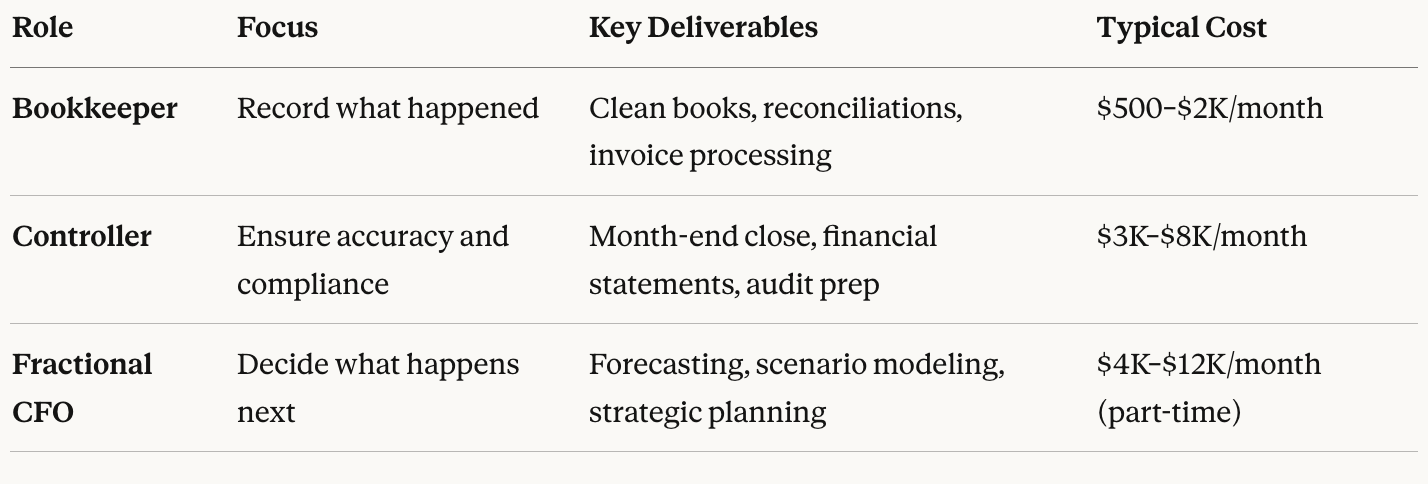
Most $3M–$10M businesses need all three—but the CFO function is the one that prevents surprises and protects margin.
How to Choose the Right Fractional CFO
Not all fractional CFOs are created equal. Look for someone who:
Has operated in your industry or business model
Professional services firms have different cash dynamics than SaaS or e-commerce. Industry experience matters.Builds systems, not just reports
You don't need another spreadsheet. You need a repeatable forecasting cadence and decision framework.Communicates in plain language
Finance should clarify, not confuse. If your CFO can't explain the model to your team, it's not useful.Has led finance through growth
Theory is fine. Experience scaling $2M to $10M is better.
The Cost of Waiting
The cost of not having strategic finance support isn't always obvious—until it is.
When I owned a boutique hotel, our hot spring well failed. Repair cost: $20,000. Unplanned. Non-negotiable.
Because I had a rolling cash forecast, I didn't panic. I saw exactly what I was working with: guest deposits clearing in 10 days, payroll in 14 days, a vendor payment I could push by two weeks. I staged the repair payment, accelerated collections on a corporate booking, and delayed a lower-priority purchase.
No emergency line of credit. No scramble. Just decisions made with time and clarity.
The forecast didn't prevent the expense. It prevented the crisis.
That's the value of strategic finance: turning reactive firefighting into proactive decision-making.
Final Thought: Build the Cadence. The Clarity Follows.
Forecasting isn't about predicting the future perfectly. It's about preventing surprises early enough to do something about them.
If you're leading a $2M–$10M professional services firm and you're making growth decisions without a cash forecast, you're managing risk you can't see.
The discipline of forecasting matters more than the precision of the model—especially in the first six months.
Build the cadence. The clarity follows.
About Francis Royce
We provide strategic fractional CFO services for founder-led professional services firms. With experience as both a business owner and an engagement financial manager at Deloitte, Angela helps growing businesses install decision-grade forecasting, cash discipline, and margin clarity—so growth doesn't blindside you.
Ready to build financial clarity into your business?